

Read the previous post by Joseph Osmundson
Read the next post by Helen Betya Rubinstein
I laughed in recognition at the very first sentence of Jamie Zvirzdin’s lecture: “It is no secret that science writing is often abysmally inaccessible, even for the initiated—like a bizarre ancient ritual that even its most faithful modern practitioners don’t understand but pretend they do.” When my neuroscientist brother generously sent me an early published paper (among other things, he’s a MacArthur Fellow now), I was able to see only subjects, predicates, and various other syntactical forms; its content remained opaque.
“Humans love stories, so let us give them the science that they need in the form that they need it, using fiction’s tools,” said the essay prompt sent by KR. Of course I agree. Even had I not been asked to join in a dialog about science writing, today’s NY Times article would have caught and captured my eye.
Expert science writer Carl Zimmer’s Updated Brain Map Identifies Nearly 100 New Regions was sub-headed MATTER, which to my ear echoed the title of the story KR had accepted for the special Poetics of Science issue: “What Can the Matter Be?”
Could anything then be more serendipitous than to read:
In the 1950s, for example, German researchers noticed a patch on the side of the brain in which neurons had little myelin, compared with neighboring regions. But the finding was soon neglected. “People tended to ignore it, and it was lost in the literature,” said Dr. Van Essen. The computer rediscovered the odd territory, and Dr. Van Essen and his colleagues found that it becomes unusually active when people listen to stories. That finding suggests the region, which they call 55b, is part of a language network in the brain, along with Broca’s area.
Long ago, I wrote a (twice-published) poem, “The Two Cultures,” inspired, as Zvirzdin notes, by the 1959 lecture of “British physical chemist and novelist named Charles Percy Snow.” Another “of course”—as a writer of fiction, poetry, and drama, I come to the topic of science writing from the other culture entirely. Along with that author, I wanted to help with bridge building:
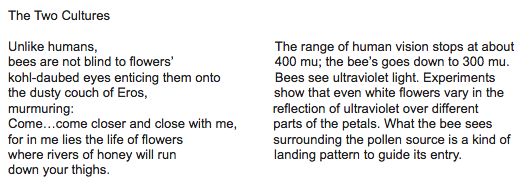
(Click on image to read poem.)
Long before I knew the word metaphor, the first story I ever wrote was in fifth grade in the late ’50s, personifying a solar prominence as the expression of the Sun’s anger. But I grew up in a home where a microscope and a chessboard were my older brother’s forbidden prized possessions, and I was his nuisance younger sister. My earliest reading included my father’s Grey’s Anatomy on his office shelf. Fascination with its illustrations and wonderful words gained me some paternal approval.
The sibling rivalry between Science and Story that began in the nineteeth century (and for me, in the twentieth) has always been grounded in family metaphor. I read my brother’s sci-fi and then found favorites of my own, like Asimov’s Nine Tomorrows and The End of Eternity. I read The Origin of Species as if it were just another book on the shelf, which it was. I don’t remember which one of us first found Mr. Tompkins in Wonderland by George Gamow or Edwin A. Abbott’s Flatland, but I have no doubt that both have inspired scientists/storytellers alike.
From the nineteeth century, much fiction emphasized the dystopian dangers of science or described phenomena before they were discovered or named (like Stevenson’s astonishing 1886-before-Freud fragmented telling of mental breakdown in The Strange Case of Dr. Jekyll and Mr. Hyde, the equally inexplicably prescient 1909 story by E.M. Forster “The Machine Stops,” Huxley’s Brave New World, and Orwell’s 1984). But in the twentieth century, some authors, like John Updike, recognized that serious contemporary fiction had to “speak” science since it had become the ground of modern being. At one point two decades ago, I emailed Harold Bloom at Yale to ask him if Shakespeare had ever written about the future (other than about dynastic anxiety), and I treasure his approving agreement that no, the Bard had not.
Whichever side of the cultural bridge we start from, and before AI overtakes us all (and leads the way beneficially—I’m an optimist), writing today needs both novelty and context, Imagination and Memory. In allusive, metaphorical terms, Evolution not only allows but also insists on both. If we write textbooks or stories lacking either, we’re one-eyed, ungrateful mules . . . and sterile. Nature doesn’t throw out the baby with the bathwater.
It’s a false dichotomy to ask: “Does the dramatization of scientific discovery shift attention from science to character, or does it humanize the scientific process for readers?” It does both in the most delightful way.
Comments from other contributors to the Poetics of Science online discussion:
Karen Luper: There’s a lot to think about here, and in such a good-sized group much has already been touched upon even if not in direct response to this post. Back to the pleasure and the sense of awakening (literally, apparently—so some call it area 55b!) that come with stories—these are an indication of the power of story, which we’re all familiar with, and leads, as we think about science and its authority, to obvious questions of how that power is put to use. Does storytelling in science carry a different weight, or a different responsibility? Are the consequences different for getting the story wrong? “Survival of the fittest” is a good example of getting the story of evolution very wrong. And Jamie Zvirzdin talks about how hard a story is to shake, once it’s stuck. So I like to be careful with this idea of story, with the balance of precision and lyricism, and with an awareness of intent, too—whether it’s to educate, indoctrinate, include on a journey of exploration, bolster any number of agendas, deceive . . . the list is long, and I don’t mean to tilt it toward the negative—I’m only painfully aware of some of the abuses. It’s a precious charge, this work.
L. Shapley Bassen: Labor Day today . . . computer finally died, and it’s a difficult adjustment to the new one we had waiting. But I wanted to add the result of a conversation I had ABOUT the Poetics of Science conversation . . . re allergory and metaphor. The best explainer I know offered that “analogy CLARIFIES while metaphor DRAMATIZES.” After the thoughtful, lively KR talk about the two words/methods . . . I hoped that definition might help others as much as it does me.